

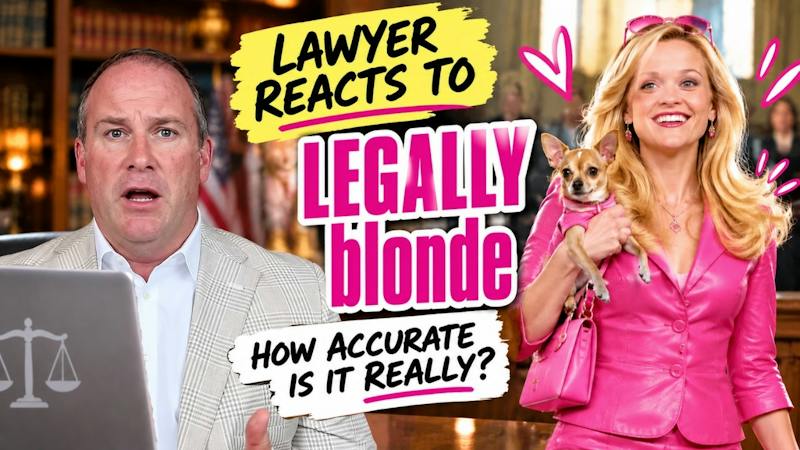
Bend and snap your way over here, because we did something a little different.
We handed HGD attorney Erik Heninger a copy of Legally Blonde, a bag of popcorn (okay, maybe not the popcorn), and one very important question: how accurate is this movie, really?
Erik grew up watching movie critics give thumbs up and thumbs down, so when we challenged him to swap his usual “what to do after a car accident” advice for a full-on movie review, he was in. The result? Brutally honest scores, a few surprising lessons, and at least one confession about the LSAT.
Watch the full video: Lawyer Reacts to Legally Blonde | How Accurate Is It Really?
“What, Like It’s Hard?” (Yes, Erik Says. It Is.)
Let’s start with Elle’s jaw-dropping 179 on the LSAT. For context, the test is scored from 120 to 180. Erik’s own score? He jokes it was “probably a 122.”
His take: the LSAT is packed with logic games and reading comprehension, and those logic games are “insane.” A 179 isn’t impossible, but Erik’s honest assessment is that it would take a lot of brains and a little luck.
But can a fashion major really go to law school? Absolutely. You can major in just about anything. Erik studied English and philosophy, and he’s worked with lawyers who majored in biology, math, and criminal justice. It’s not about the major. It’s about whether you can dig into tricky facts, find what matters, and think on your feet.
Sorority president? That actually counts! Erik says leadership experience shows admissions teams that people trust you.
The admissions video instead of an essay? “It’s not normal,” Erik laughs. “I’ve never heard of people doing videos.” Pro tip: write the essay.
Hot Pink vs. a Sea of Brown
Remember Elle strutting into her first day in head-to-toe pink while everyone else looked like they rolled out of bed? Erik’s verdict on the frumpy classmates: 100% accurate.
“Everybody’s tired and worn out,” he says. “We may have taken a shower, may not have.” Expect sweatshirts, “backpacks galore,” and “a lot of brown.” Porsches and Chihuahuas? Not so much.
What the movie does get right is the competition. Law school is cutthroat, and students really do battle for top grades. Earn the highest grade in a class and you “book” it, a tradition that started when the prize was literally getting to keep the textbook. (Erik would have preferred a McDonald’s gift card.) Fun fact: his father holds the record for the most booked classes at his law school. Erik booked a couple himself, but says that apple “did not translate” quite as far.
A First-Year on a Murder Trial? Objection!
Here’s where things get a little Hollywood. Professor Callahan is a full-time professor and a big-shot attorney on a high-profile murder case, and he’s so swamped he needs first-semester students to help.
Erik isn’t buying it. Busy lawyers at top firms are usually billing clients, not teaching core classes. And a first-semester student on a murder trial? “This is starting not to add up really well.”
Then Elle stands up in court to question a witness herself. Erik notes that rules vary across all 50 states. In Alabama, for example, law students who take certain trial advocacy classes can earn a third-year bar card. That lets them handle limited, lower-stakes matters under a licensed attorney’s supervision. Murder trials are not on the list.
Would a judge sign off on Elle? In the states where Erik practices, he doesn’t see it happening. A person accused of a crime has constitutional rights, including the right to be represented by a lawyer.
The Courtroom Scene Actually Teaches Something
Plot twist: Erik found a real lesson hiding in the big trial scene.
At first, Elle reads straight from her notes and struggles. The moment she sets them down and just talks to the witness, on a subject she knows inside and out, she nails it. That’s exactly what trial advocacy classes teach: get away from your notes, because you’re not listening if you’re reading. Erik puts it in the same category as My Cousin Vinny: wildly unrealistic, but with a few gems tucked inside.
What doesn’t hold up? The dramatic “I didn’t mean to shoot him!” confession. Real witnesses are usually well prepared, and there’s no magical Matlock moment. “I wish it happened,” Erik admits. “It’d be a lot more fun in the courtroom if it did.”
Also, sorry Bruiser: no Chihuahuas in handbags at counsel’s table. 🐶
The Verdict Is In
| Category | Erik’s Score (out of 10) |
| Realistic law school experience | 2 |
| Accuracy of the trial scene | 5 |
| Elle being allowed to act as a lawyer at all | 1.5 |
| How much he enjoyed the movie | 7.5 |
That’s right: low marks for realism, but a solid 7.5 for fun! “It was entertaining,” Erik says. “You’re always rooting for the underdog.” (Even we were surprised. We thought he’d give it a 2.)
His favorite takeaway? Law school doesn’t automatically make you great in a courtroom. Some people just have the instincts. In fact, Erik thinks his wife would be an excellent cross-examiner, because “she cross-examines me every day.”
Grab Your Popcorn
Want the full review, Erik’s best reactions, and a few bloopers at the end? Watch Lawyer Reacts to Legally Blonde on YouTube.
Then tell us in the comments: which legal movie should Erik review next? A Few Good Men? My Cousin Vinny? Erin Brockovich? We’re taking requests.
This article is for entertainment and general information only and is not legal advice. Rules for law students and court practice vary by state.