
Most trial lawyers learn the hard way. They pick up habits in their first few years of practice, some good and some not, and spend the rest of their careers either leaning on the good ones or trying to unlearn the rest.
Steve Heninger would rather reach them sooner.
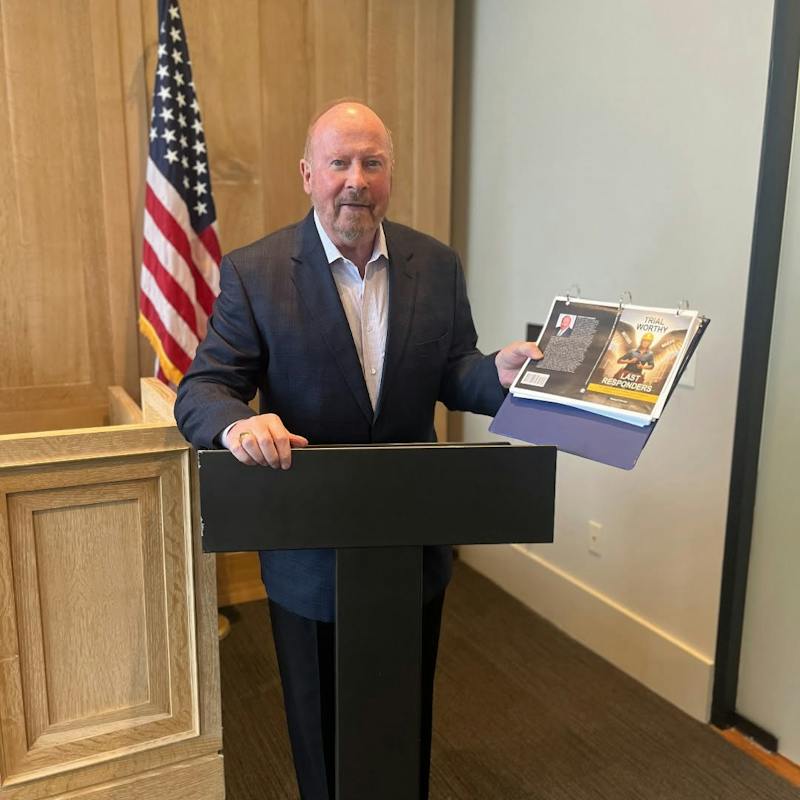
After years of speaking to and writing for practicing lawyers around the country, the HGD founding partner has taken that experience into the classroom. He now teaches Persuasive Trial Techniques at Cumberland School of Law in Birmingham.
“I wanted to move into the law school garden and fertilize them while they’re young and without established bad habits,” he said.
What does the course cover?
Each class follows a simple rhythm. Steve spends about 40 minutes lecturing on the topic of the day: depositions, jury selection, opening statements, direct and cross-examination, closing argument, and plenty more. Then the students get up on their feet and put the lesson to work.
There are 15 students in the room, so time is always tight. Everybody needs reps, and there is only so much clock.
The written material comes mainly from Steve’s own book, Trial Worthy: Last Responders, which makes the case for trading paper wings for toolbelts in courtroom persuasion. Presentations and writings from other great trial lawyers are mixed in.
A few war stories make it into the discussion too, trial scars along with the occasional lucky break. He keeps those on a short leash. “I try to minimize those so it doesn’t become about me,” he said.
What does “explore, then consume” mean?
If students leave with one phrase, it is probably this one. Steve repeats it constantly: EXPLORE, then CONSUME.
In a deposition, the job is to discover everything you can. At trial, the job changes. Now you are editing, deciding what the jury actually needs to hear and in what order.
“Lawyers have a tendency of dumping too much information without crafting the menu and preparing the relevant, meaningful consumption,” he said.
Anyone who has watched a trial sink under a pile of exhibits knows what he means. A stack of facts doesn’t persuade anybody. A story that has been thought through does.
Whose story is it, anyway?
Another lesson is harder because it is personal. “It is also a challenge to get each of us to recognize that the trial story is not about me,” Steve said.
Notice the “us.” He counts himself in that group. The lawyer’s job is to present the client’s story and to understand how much the jury can take in and feel. The slickest performance in the courtroom is worth very little if jurors walk out without understanding what happened to the person at the center of the case.
How does he help students get past the fear of being judged?
This is the part Steve cares about most. His overriding goal is to get students to be open and vulnerable about their own insecurities, especially the fear of being judged by others.
His advice on that front is about as blunt as it gets.
“Jurors will judge us. Get over it. Make fear a passenger, not the driver.”
He is also candid about what any one teacher can offer. “I don’t pretend to have all the answers to persuasive techniques,” he said, “but I believe I can spotlight the salient questions.”
Why would a student examine a witness in French?
Sometimes the way through discomfort is a little more discomfort.
In a recent class, Steve had one student examine a witness entirely in French. She did not speak French. It was every bit as awkward as it sounds, and that was the whole idea. When she was allowed to switch back to English, she was noticeably more relaxed and more fluid. After the hard version, the regular one felt easy.
“Once confidence shows up to support logic and emotion, magic happens,” Steve said.
He gives the students a lot of credit for moments like that. He describes them as extremely bright and willing to push their own growth, sometimes far enough that they end up teaching him something, too.
Why does authenticity matter so much in a courtroom?
Steve has no interest in producing copies of famous trial lawyers. The class puts a heavy emphasis on authenticity and finding your own voice, rather than becoming a “knock-off” of someone with a bigger reputation.
He describes it in garden terms, which by now should not surprise anyone.
“We don’t plant plastic storytelling flowers in this garden. We plant seeds in the soil of humanity and hope watering them with practice produces individual flowers strengthened by their own characteristics.”
And in case anyone finds that a bit much: “If that sounds too touchy-feely, I do not apologize.”
There is a practical reason behind the philosophy. Jurors can tell when something is put on. They tend to trust the lawyer who is simply being himself or herself, and that kind of trust is hard to fake.
What does this mean for HGD clients?
The habits Steve teaches at Cumberland are the same ones he brings to his own cases: dig deep in discovery, cut the story down to what matters, keep the focus on the client, and leave the ego in the hallway. As a founding partner, he helped build HGD on those standards, and they carry across our 14 attorneys and the 30-person support team that works alongside them.
For Steve, the classroom is one more place to do what he has always tried to do in the courtroom: help people tell a true story well. He is planting seeds 15 students at a time and watching what grows. If a cross-examination in a language nobody in the room speaks is any sign, the garden is coming along just fine.