
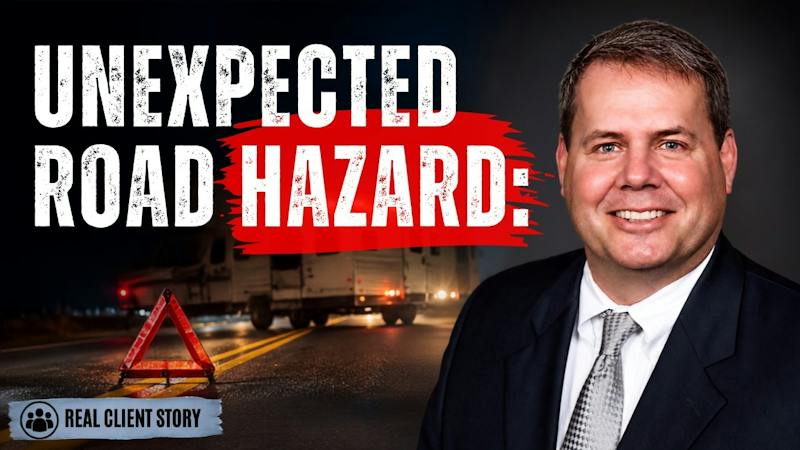
"They said, 'You should have seen it.' Well, that's not the case."
Those words come from a Heninger Garrison Davis attorney describing a client who was blamed for her own injuries after a crash she never saw coming. It is one of the most common arguments injured drivers hear. Here is why it often leaves out the most important part of the story.
▶ Watch: Unexpected Road Hazards: Who Is Liable for a Serious Accident? | Real Client Story
30 years, the same road, and a camper in the dark
For 30 years, our client drove the same route to her factory job, leaving home at 5:00 a.m. She is a mother and a grandmother, and she knew that road by heart.
One morning, a local store owner was moving a large camper across the highway. There were no flaggers and no warning signs. In the early-morning darkness, she collided with the camper in the middle of the road and suffered serious injuries to her ribs, head, and neck. The attorney shares that she now faces spending her golden years in pain.
The other side's response? She should have seen it.
4 reasons that argument may not hold up
1. A hazard in the road should come with a warning. As the attorney puts it, this hazard should never have been there, and if it was, a warning should have been provided. The focus belongs on whoever created the hazard.
2. Moving cargo across a highway is allowed, but it comes with responsibilities. Store owners and landowners sometimes need to move equipment or vehicles from one side of a road to the other. When they do, a traffic control plan and flaggers help stop and warn oncoming drivers. In this case, neither was in place.
3. Darkness changes what any driver can see. At 5:00 a.m., a large object sitting across the lanes can be very hard to spot in time. The attorney notes that the excuse "doesn't hold water" when something is moved across the road at night without warning.
4. A familiar route creates reasonable expectations. After decades on the same road, a driver reasonably expects it to look the way it always has. Nobody expects a camper parked across the highway. That is exactly why warnings matter.
What a proper warning can look like
When something is being moved across or blocking a public road, safety measures may include:
-
Flaggers positioned to stop traffic in both directions
-
Warning signs placed well ahead of the crossing
-
Cones, lights, or reflective devices visible in the dark
-
A planned time and route for the move that limits risk to drivers
If none of these were in place when you were hurt, that is an important question to raise with an attorney.
If this happened to you
Maybe you have replayed the crash and wondered whether you should have stopped sooner. As the attorney says, "Don't blame yourself." You did not choose to be put in a dangerous situation.
A few steps that can help protect your claim:
-
Get medical care right away, even if you feel okay.
-
Photograph the scene, the hazard, and any missing warnings if you can.
-
Write down the time, lighting, and weather conditions.
-
Talk with an attorney before giving a statement to an insurance company.
Talk with Heninger Garrison Davis
When someone creates a hazard on the road and fails to warn drivers, the people hurt deserve answers. Our team is here to help clients just like the one in this story. Reach out for a free consultation, or watch the full video on YouTube.
No representation is made that the quality of legal services to be performed is greater than the quality of legal services performed by other lawyers. Past results do not guarantee future outcomes.