

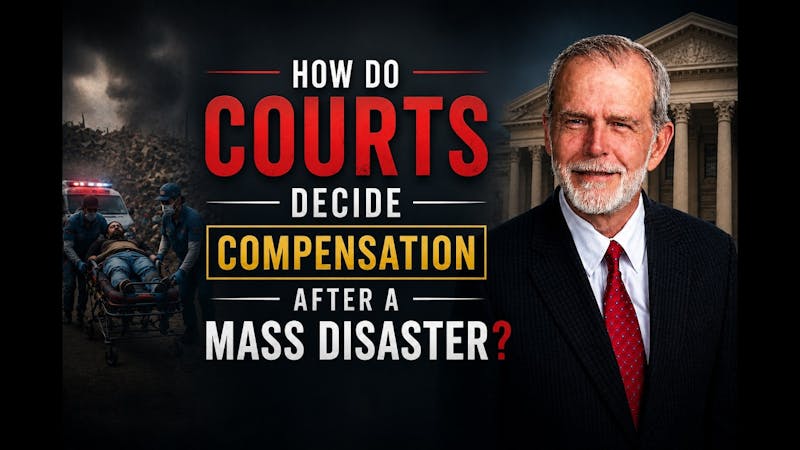
When a train derailment, industrial fire, environmental spill, or other large-scale disaster affects hundreds or even thousands of people, one of the most important legal questions is: How do courts determine who should be compensated? Mass-disaster cases present unique challenges because many people may suffer property
damage, health effects, financial losses, or other harm from the same event.
Courts and the attorneys involved must find an effective way to evaluate those claims while ensuring affected individuals have an opportunity to pursue fair compensation.
In the video “How Do Courts Decide Who Gets Compensation After a Mass Disaster?”, HGD partner Chris Hood discusses how these complex cases may be handled and the methods courts can use to evaluate claims.
Watch Chris Hood explain the process:
Mass Disasters Can Affect Thousands of People
Mass-disaster litigation can arise from many different events, including:
- Train derailments
- Large industrial fires
- Environmental spills
- Chemical releases
- Other incidents affecting large communities
In some cases, thousands of people may be adversely affected.
The challenge is that while these individuals may have been harmed by the same event, the extent and nature of their damages can differ. One person may experience damage to a home or other property, while another may have concerns involving exposure to potentially harmful substances.
Determining appropriate compensation, therefore, requires understanding both what happened during the disaster and how individual people were affected.
Building the Evidence Behind a Mass-Disaster Claim
Before a court can evaluate compensation, attorneys representing affected individuals must investigate the circumstances surrounding the disaster and develop evidence supporting their clients' claims.
Depending on the incident, this may require working with experts.
Following a large industrial fire, for example, experts may investigate what combustion products or potentially harmful substances were released. After an environmental spill, an investigation may examine which chemicals or liquids entered the environment, how those substances traveled, and whether they reached a client's home or property.
That evidence can help establish the connection between the disaster and the harm claimed by affected individuals.
Once the relevant information has been gathered, attorneys can present the claims and supporting evidence to the court.
How Class Certification Can Affect Compensation
One way courts may manage a large number of similar claims is through a class action.
Through a process known as class certification, a court may determine that people affected by an event can proceed together as a class when the applicable legal requirements are satisfied.
Typically, one or more representative plaintiffs pursue claims that reflect issues common to the larger group.
The court can then evaluate the representative claims, including, through trial when appropriate, addressing issues affecting the class.
Importantly, being part of the same class does not necessarily mean that every person has suffered identical damages or will receive identical compensation. The amount and type of damages can vary from one person to another.
As Chris explains, differences in damages do not automatically eliminate the common characteristics that may allow claims to proceed together.
What Happens If a Class Is Not Certified?
Class certification is not the only way to handle mass-disaster claims.
When claims do not proceed as a certified class, affected individuals may pursue their claims individually. With a very large number of claims, however, evaluating each one can become complicated and time-consuming.
Courts may use additional procedures to help manage that process.
One possibility discussed by Chris is the appointment of a special master. A special master can assist the court with assessing individual claims and making recommendations or determinations regarding their value, depending on the authority provided by the court.
Special masters may also play a role when defendants seek to resolve large numbers of claims through settlement.
How Is Compensation Ultimately Determined?
There is no single formula that applies to every mass-disaster case.
The method used can depend on factors such as the nature and scale of the event, the number of people affected, the similarities and differences among their claims, the evidence of harm, and whether the claims are litigated or resolved through settlement.
As Chris explains, two important approaches may include:
- Class proceedings, in which representative plaintiffs pursue issues common to a larger group; or
- Individual claim processes, which may involve court-appointed special masters or structured settlement procedures.
The appropriate approach depends on the circumstances of the particular case.
Experience Matters in Complex Mass-Disaster Litigation
Mass-disaster cases can require extensive investigation, expert analysis, coordination among large numbers of claims, and an understanding of the procedures courts use to manage complex litigation.
Chris Hood and HGD have experience representing clients in matters involving mass disasters, including train derailments, industrial fires, and environmental incidents.
For people affected by these events, understanding how claims are evaluated is an important first step toward understanding their legal options.
This article is for informational purposes only and does not constitute legal advice. The procedures and potential outcomes of any legal matter depend on the specific facts and applicable law.